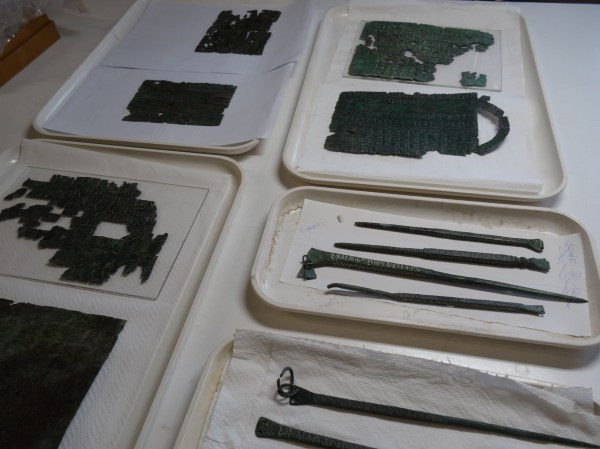
One of my favourite things about studying an unusual language is that your research is very memorable. Once people associate you with a particular obscure language, they will immediately think of you whenever they hear about it elsewhere. And - even better - they will send you sources that you never could have found otherwise.... Continue Reading →
Review: Communication and Materiality
Here's my "Classics for All" review of Communitcation and Materiality: Written and Unwritten Communication in pre-Modern Societies. If you'd like to read the book, or selected chapters from it, you can currently download it for free from the De Gruyter website. Mostly a very good read, which introduced me to a lot of sources I wasn't familiar with... Continue Reading →
The problem with long alpha
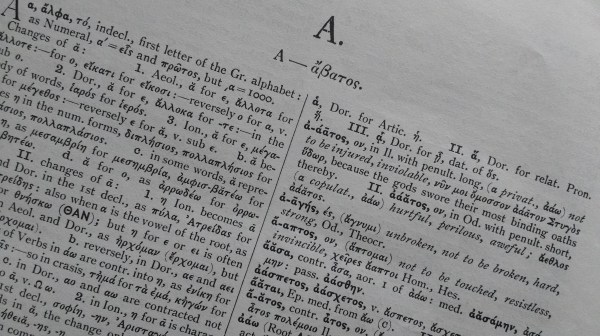
This week, a lot of us who teach Classical Philology and Linguistics at Cambridge have been teaching our first essay of the first year course on the sounds of Greek and Latin. I had a request from a student for a good example of the difference between long and short alpha, which really stumped me for a... Continue Reading →
“Oscan in Southern Italy and Sicily” is out this week
I'm very excited to announce the publication of my book Oscan in Southern Italy and Sicily. The editor very kindly dropped the first copy round to my house last night, and I'm really pleased with how it has turned out. This book started life as my PhD thesis (pictures of its journey from thesis to book... Continue Reading →
Building a Corpus of Ancient Venetic
For the past few weeks I've been doing something which has been rewarding and frustrating in almost equal measure (in between some weekends visiting family in Sussex and Yorkshire, with some Roman sites and a grinning she-wolf thrown in): namely, building up a complete corpus of all the extant inscriptions in the ancient Venetic language.... Continue Reading →
From Neapolis to Calimera (aka Greek in Italy goes to Italy)
Last week was our second "Greek in Italy" project trip to the south of Italy. Like our last trip in September 2014, I'm sure that pictures and thoughts from this trip will keep bubbling up in my blog posts and articles for quite some time. But even though we've only just got back and I've... Continue Reading →
Why Historians and Linguists Should Read the Ibis Trilogy
Historians and linguists of the world: you should be reading Amitav Ghosh's Ibis Trilogy - Sea of Poppies, River of Smoke, and the recently released Flood of Fire. (For those who have already started Flood of Fire, don't worry, there are no spoilers ahead.) I'm hoping the historians don't need too much convincing. Ghosh's trilogy... Continue Reading →
Language and Society in the Greek and Roman Worlds
I've just finished reading James Clackson's new book Language and Society in the Greek and Roman Worlds - a book I will undoubtedly be adding to all my undergraduate reading lists before next term starts. The book offers an accessible but thorough introduction to the languages of the ancient world and how they were used across time and space -... Continue Reading →
Two Latin words for elephant
There are two words for “elephant” in Latin, and both have to do with Greeks in Italy. The first one, elephantus (or sometimes elephas or elephans), is fairly straightforward. It’s used in Latin from about the second century BC, and it’s a borrowing of the Greek word ὁ ἐλέφας, –αντος. That’s the normal Greek word for both African and Indian elephants, and is... Continue Reading →