Seneca, Cicero and the Doctor

One of the odd things when you learn Latin is that you start to see it everywhere. It's so embedded into Western culture, that you need look no further than your own pocket to find some Latin (assuming you have a couple of coins in your pocket, that is). But what's even weirder is that... Continue Reading →

Corfinium – Italia or Italica?

Over the Easter holidays, I've been reading Mary Beard's SPQR, which I highly recommend. I was particularly pleased that so much of it focusses on early Rome and its relationship with Italy - it was at least a third of the way through before we even got to Sulla. Mary, as usual, brings out all... Continue Reading →

Reblogged – What the digamma?

An excellently Classical post appeared on the Strong Language linguistics blog last week after someone found the phrase "what the digamma?" in a poem of 1881. I'll let you read Ben Zimmer's musings on whether this is a joke replacement of "what the dickens" or is meant as something closer to "WTF". The comments give... Continue Reading →

Rome, Tarquinia and Ceveteri

I've just got back from my RAC/TRAC 2016 trip, and I can't leave it too long before posting some pictures. The conference was absolutely excellent, and it was a joy to catch up with some old and new friends over at La Sapienza. Highlights of the conference for me included Maureen Carroll's paper on the votive... Continue Reading →

RAC/TRAC 2016 Update

I'm off to RAC/TRAC 2016 (the Roman Archaeology Conference and Theoretical Roman Archaeology Conference). There will be a bit of a break in my blogging, but lots of photos to share when I get back. My paper is in Greg Woolf's panel on standardisation tomorrow morning. You can preview my slides by downloading them here. If you're... Continue Reading →

Vale soror anima mea – Roman women’s writing

Happy International Women's Day everyone! In this part of term, we usually teach a supervision about ancient gender linguistics - specifically, we ask students whether there is evidence for women speaking Greek and Latin differently from men. This quickly becomes a frustrating question, because almost all of the evidence we have for women speaking was... Continue Reading →

Plautus and plavtad

Here's a nice post by Matteo Calabrese on the meaning behind the name of the Roman dramatist Plautus, with a reference back to the post I wrote on the Pietrabbondante tile in January. If you were wondering, his name is derived from a nickname meaning "flat-footed" - but as far as I know, we can... Continue Reading →

I, Sicily

I've recently started on a very exciting new collaboration with the I.Sicily project, which is building a fully searchable, freely available online corpus of the inscriptions of Sicily. (In my head I keep turning this project into "I, Sicily" in the manner of "I, Claudius" - this sounds quite dramatic, so I'm sticking with it.) To... Continue Reading →

Dedication to Mefitis

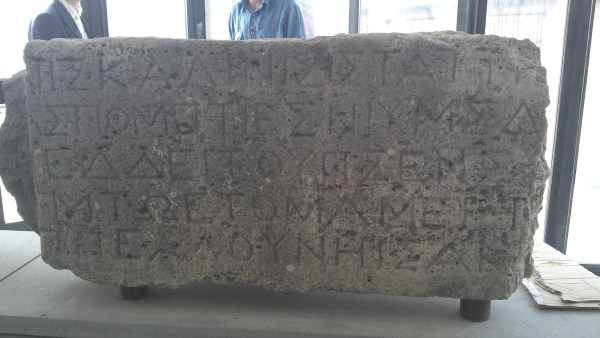
    μεfιτει μαρασ σταλλιεσ βρα τεισ δατ[α]σ To Mefitis, Maras Stallies, for grace given Oscan inscription in the Greek alphabet. Rossano di Vaglio, 325-275 BC. Imagines Italicae: Potentia 13; Sabellische Texte Lu 16. This is an inscription on stone, found at the sanctuary site of Rossano di Vaglio (pictured below) in central Lucania, modern day... Continue Reading →

Create a website or blog at WordPress.com

Up ↑