The Partial Historians podcast uses Roman historical sources to discuss the founding of Rome and the city's early history. This week, they use accounts by Dionysius of Halicarnassus and Livy to talk about the Roman relationship with their Oscan-speaking neighbours in the fifth century BC. I love the style of this podcast - their close... Continue Reading →
Blog
Talk: Writing women
At 5pm on the 26th April, I will be presenting at the Newcastle Classics research seminar on "Writing women: understanding the goddess Reitia". I'll be talking about my recent work on literacy and the dedications to the goddess Reitia at Este, which I've spoken about already in Exeter. The seminar will take place in Room 2.50... Continue Reading →
Podcast: Distant Pasts
Last week (just in time to coincide with both the "Greek in Italy" workshop and the triggering of Article 50) I was featured on a podcast series presented by my colleague Richard Flower. Distant Pasts: Adventures in an Alternative Antiquity looks at some of the more surprising, unusual and lesser known aspects of the ancient world,... Continue Reading →
Talk: HiSoN 2017, New York
I'm very excited to be speaking this week at the Historical Sociolinguistics Network Conference (HiSoN) 2017 in New York, hosted by NYU and CUNY Graduate Centre. I hugely enjoyed HiSoN 2015, and met some lovely people doing fascinating work there, so I'm looking forward to this year's conference hugely. I'm speaking on the first day of... Continue Reading →
Survey: Employment in Classics in UK universities
I am currently conducting a survey, open to anyone working or studying in a Classics/Ancient History department in the UK. The aim is to find out about employment practices and contract types in use in Classics departments, and the impact these have on staff and students. The survey will be open until the 31st May... Continue Reading →
A cathedral field trip
One of my academic specialisms is the study of inscriptions, otherwise known as epigraphy. Most of the material I work with is epigraphic, and sometimes this is one of the biggest challenges in my work. Learning how to read inscriptions is a skill that you need to learn by trial-and-error and, ideally, by having someone with... Continue Reading →
‘Greek in Italy’ in Rome
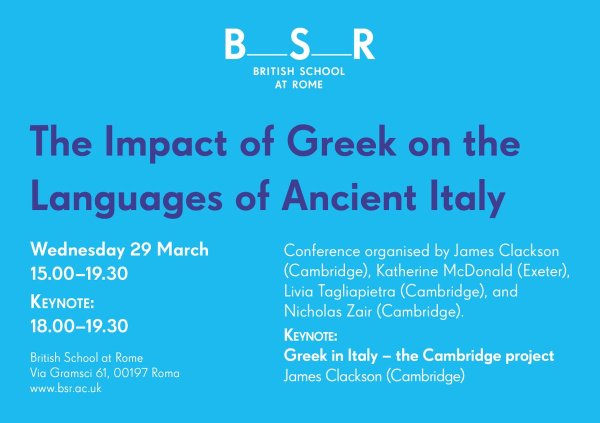
On the 29th March, the 'Greek in Italy' project will be hosting a workshop entitled 'The impact of Greek on the languages of Ancient Italy' at the British School at Rome. We are very privileged to have several great Italian linguistic scholars with us for the afternoon - you can see the full programme over... Continue Reading →
Three archaeological poems by Thomas Hardy
Thomas Hardy was one of my favourite authors as a teenager (my friend and I had a challenge to try to read all of his novels, which we didn't quite manage). I never read much of his poetry, probably because 15-year-old me was more interested in stormy Victorian romances, but I was revisiting some of... Continue Reading →
Reblogged: Learning the alphabet
This morning the blogosphere has obligingly brought me the answer to a question I couldn't answer yesterday. Natalia Elvira Astoreca, of the CREWS project in Cambridge, has written a blog post on the different ways that people learn the alphabet in modern Europe. A colleague asked me a question about this at my talk yesterday, which I... Continue Reading →
Talk: Reitia and the epigraphic habit of Este
This Wednesday, I am giving the Classics and Ancient History research seminar at Exeter. The paper will be based on brand new research I have been doing on the dedications to the goddess Reitia at Este. Here is the abstract: The epigraphic culture of the Veneto region is full of contrasts, particularly between its two... Continue Reading →