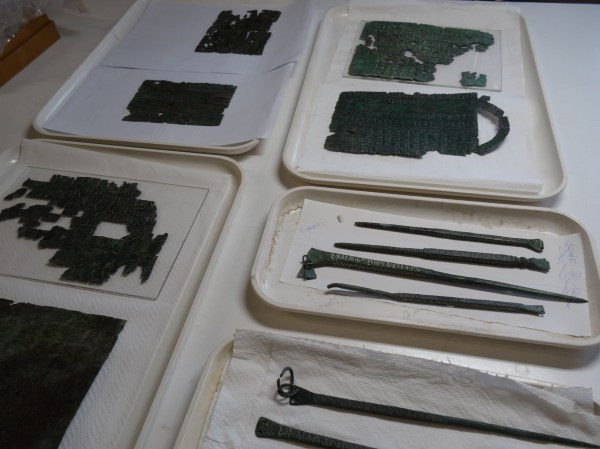
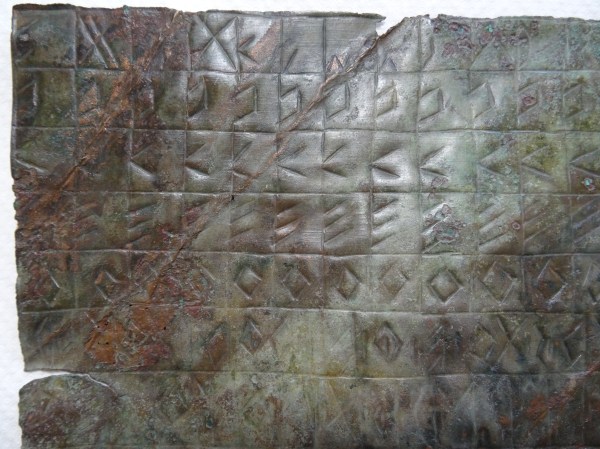
One of my favourite things about studying an unusual language is that your research is very memorable. Once people associate you with a particular obscure language, they will immediately think of you whenever they hear about it elsewhere. And - even better - they will send you sources that you never could have found otherwise.... Continue Reading →
Was there non-Roman literature in Ancient Italy?
Fairly regularly, someone will ask me: was there Oscan (or Venetic or Etruscan or South Picene) literature? Or, sometimes a bit more aggressively, someone asserts that there definitely wasn’t an Oscan literary culture and therefore that Oscan-speakers and their societies were just less advanced than the Greeks and/or Romans. It's not that I think this... Continue Reading →
Greek in Italy at the Festival of Ideas and the Fitzwilliam Museum
The Cambridge Festival of Ideas rolls around again this week, with lots of great events to get involved with, including a lot of events in the Classics Faculty. As always, the Greek in Italy project has made a couple of contributions. Geoff's talk "Did Language Matter? Local Versus Imperial Languages in Classical Antiquity" has already sold... Continue Reading →
Reblogged: Samnites in Pompeii
A great post here on the new Samnite grave in Pompeii by Virginia L. Campbell. She's also posted about the Oscan epigraphy of Pompeii here. A new discovery at Pompeii is always an exciting event, and even more so when it's from the 'Samnite' period of the town rather than its final destruction. I'm looking... Continue Reading →
“Oscan in Southern Italy and Sicily” is out this week
I'm very excited to announce the publication of my book Oscan in Southern Italy and Sicily. The editor very kindly dropped the first copy round to my house last night, and I'm really pleased with how it has turned out. This book started life as my PhD thesis (pictures of its journey from thesis to book... Continue Reading →
The Mysterious Case of the 112-year-old Woman
ahvdiú. ni. akun. CXII Ahvdio daughter of Ni. 112 years Oscan inscription on plaster. Teanum Sidicinum, c. 200 BC. Imagines Italicae: Teanum Sidicinum 24; Sabellische Texte: Po 51. People have struggled with Ahvdio's gravestone. On the one hand, the Roman numerals at the end of the inscription (on the left-hand-side of the picture) look quite... Continue Reading →
Building a Corpus of Ancient Venetic
For the past few weeks I've been doing something which has been rewarding and frustrating in almost equal measure (in between some weekends visiting family in Sussex and Yorkshire, with some Roman sites and a grinning she-wolf thrown in): namely, building up a complete corpus of all the extant inscriptions in the ancient Venetic language.... Continue Reading →
Archiving the Cambridge Greek Play
The Cambridge Greek Play desperately needs a new website. Very soon, I'm pleased to say this website will become a reality, and I will certainly be plugging it and providing links when it launches. Fortunately, we are paying some highly talented and professional designers to construct the website itself, thanks to a donation reserved for... Continue Reading →
Words for “alphabet” in ancient languages
I remember when I first realised that the English word "alphabet" came from the first two letters of the Greek alphabet - alpha and beta - and somehow I felt like I'd cracked a kind of etymological code. But the list of brilliant names for alphabet terms just goes on. The word "alphabet" is of... Continue Reading →
From Neapolis to Calimera (aka Greek in Italy goes to Italy)
Last week was our second "Greek in Italy" project trip to the south of Italy. Like our last trip in September 2014, I'm sure that pictures and thoughts from this trip will keep bubbling up in my blog posts and articles for quite some time. But even though we've only just got back and I've... Continue Reading →