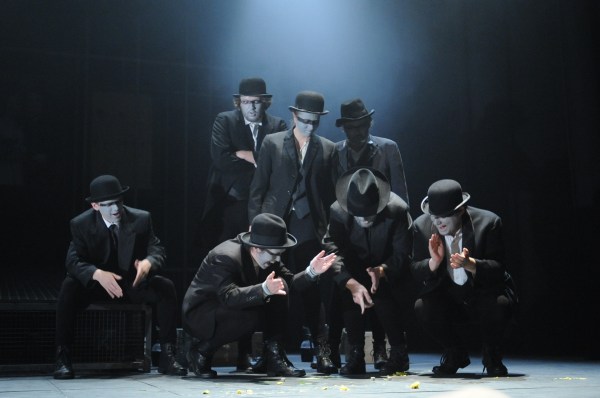
Over the past few months, I've been involved with the formation of the Women's Classical Committee UK. There's been an organisation for women in Classics in the US for a long time (the Women's Classical Caucus), and there's also an equivalent organisation in Australia and New Zealand. So when Liz Gloyn (among others) suggested a... Continue Reading →
Mapping Language Contact – Phase 1
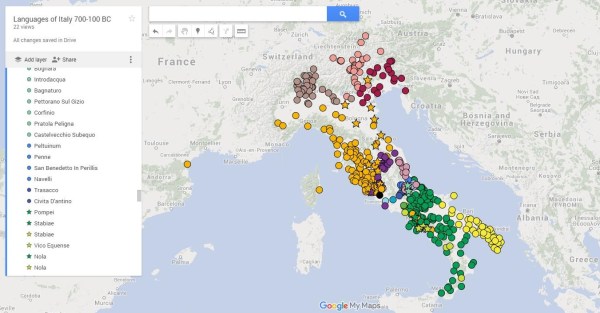
It's become a bit of a cliche for me that my academic talks tend to start with a map of the languages of Italy, followed by an explanation of why the map is dangerously misleading. The map that I normally use is from Wikipedia, and looks like this: Now, this map does the job in... Continue Reading →
Vanishing names on healing amulets
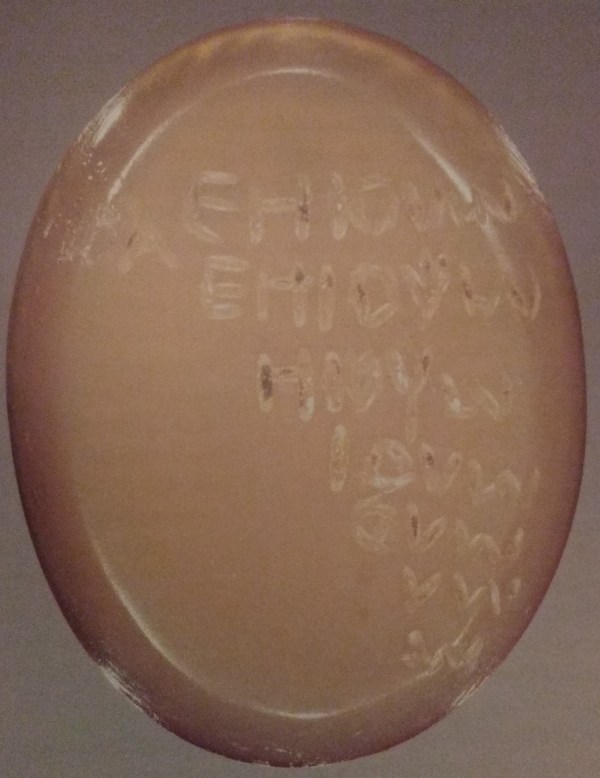
I'm reviewing a book this week called Vanishing Acts On Ancient Greek Amulets by Christopher A. Faraone. It's a short monograph that's incredibly rich in detail, using magical amulets in Greek, Latin and other languages to trace developments in how healing spells were spoken and written from the first century to the sixth century AD. In particular,... Continue Reading →
Four footprints, two languages, one tile
hn. sattiieis. detfri segnatted. plavtad herennis. amica signauit. qando. a- ponebamus. tegila(m) Detfri of Hn. Sattis signed with a footprint. Amica of Herens signed when we were laying out the tile. Oscan/Latin inscription and four shoe prints on a large clay roof tile (0.67 x 0.94m). Pietrabbondante, c. 100 BC. Imagines Italicae: Teruentum 25;... Continue Reading →
RAC/TRAC 2016
I'm pleased to announce that I'll be speaking at the upcoming Roman Archaeology Conference in March 2016, to be held at ‘Sapienza’ Università di Roma and the British School at Rome. The Theoretical Roman Archaeology Conference will be held at the same time. For now, the RAC website is a little sparse, but you can... Continue Reading →
Oscan in Early Modern Italy
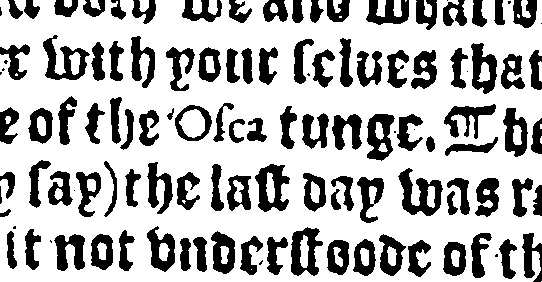
One of my favourite things about studying an unusual language is that your research is very memorable. Once people associate you with a particular obscure language, they will immediately think of you whenever they hear about it elsewhere. And - even better - they will send you sources that you never could have found otherwise.... Continue Reading →
Review: Communication and Materiality
Here's my "Classics for All" review of Communitcation and Materiality: Written and Unwritten Communication in pre-Modern Societies. If you'd like to read the book, or selected chapters from it, you can currently download it for free from the De Gruyter website. Mostly a very good read, which introduced me to a lot of sources I wasn't familiar with... Continue Reading →
The problem with long alpha
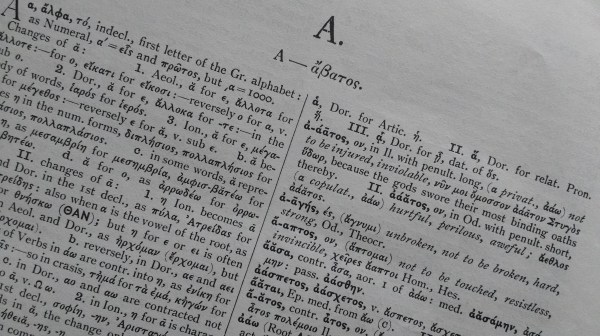
This week, a lot of us who teach Classical Philology and Linguistics at Cambridge have been teaching our first essay of the first year course on the sounds of Greek and Latin. I had a request from a student for a good example of the difference between long and short alpha, which really stumped me for a... Continue Reading →
Cambridge Greek Play Website Launch
I'm very excited to announce the launch of the new Cambridge Greek Play website! The new website is not just the place for finding out about the new productions of Antigone and Lysistrata in 2016 (which you can also find out about via @camgreekplay). It's also meant as an archive of past productions - you... Continue Reading →
Inter-city competition in the Veneto @ the Cambridge Indo-European Seminar
This Wednesday at 4.30 I'll be speaking about my new work at the Cambridge Indo-European Seminar, also known as the Philology and Linguistics Seminar. All are welcome, especially for a cup of tea at 4.15 and a drink in the pub afterwards. You can find the room details here. If you're interested, you can also download... Continue Reading →