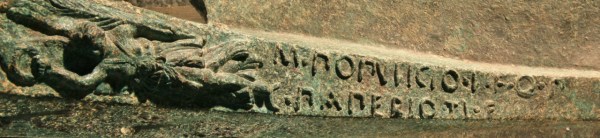
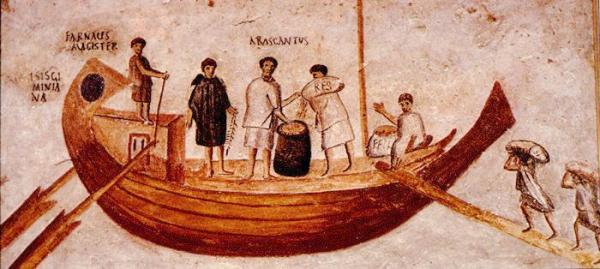
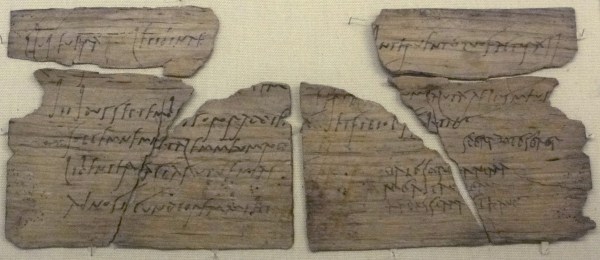
On the 27th and 28th May, the E Caucus and the Greek in Italy project are hosting the Laurence Seminar 2016, a yearly conference at the Faculty of Classics, Cambridge. This year, our theme is Migration, Mobility and Language Contact in Italy and the Western Mediterranean. Over the past decade, language contact has become a key... Continue Reading →
Talk: Becoming Roman at Este and Padua
Tomorrow I'll be speaking at the Cambridge Philological Society, 4pm in the Old Senior Combination room at Trinity College. Tea, coffee and cake is provided - all welcome! My title is Competition and Identity in Venetic Funerary Epigraphy: Becoming Roman at Este and Padua. I'm very excited about this talk, as I'll be dealing with a... Continue Reading →
The WCC Launch and an EpiDoc Workshop
It’s been a busy week for me this week, with two big events taking up all of my time. The first was the launch of the Women’s Classical Committee UK, and the second was a digital humanities workshop for training in EpiDoc XML mark-up and other digital methods. A week of contrasts, and lots of... Continue Reading →
Seneca, Cicero and the Doctor
One of the odd things when you learn Latin is that you start to see it everywhere. It's so embedded into Western culture, that you need look no further than your own pocket to find some Latin (assuming you have a couple of coins in your pocket, that is). But what's even weirder is that... Continue Reading →
Reblogged – What the digamma?
An excellently Classical post appeared on the Strong Language linguistics blog last week after someone found the phrase "what the digamma?" in a poem of 1881. I'll let you read Ben Zimmer's musings on whether this is a joke replacement of "what the dickens" or is meant as something closer to "WTF". The comments give... Continue Reading →
Vale soror anima mea – Roman women’s writing
Happy International Women's Day everyone! In this part of term, we usually teach a supervision about ancient gender linguistics - specifically, we ask students whether there is evidence for women speaking Greek and Latin differently from men. This quickly becomes a frustrating question, because almost all of the evidence we have for women speaking was... Continue Reading →
Plautus and plavtad
Here's a nice post by Matteo Calabrese on the meaning behind the name of the Roman dramatist Plautus, with a reference back to the post I wrote on the Pietrabbondante tile in January. If you were wondering, his name is derived from a nickname meaning "flat-footed" - but as far as I know, we can... Continue Reading →
I, Sicily
I've recently started on a very exciting new collaboration with the I.Sicily project, which is building a fully searchable, freely available online corpus of the inscriptions of Sicily. (In my head I keep turning this project into "I, Sicily" in the manner of "I, Claudius" - this sounds quite dramatic, so I'm sticking with it.) To... Continue Reading →
Songs about Pompeii
Most of you are probably familiar with the song "Pompeii", released by Bastille in 2013. A few weeks ago, Rachele De Felice sent me this link, of a rather nice Latin translation of the song. https://www.youtube.com/watch?v=VG_9Lw_6UrU She expressed some disappointment that the song had not been translated into Oscan, as the more ancient language of... Continue Reading →
From Oscan hirpus to English hearse
Myriapod Productions have released a rather lovely video in their "Mysteries of Vernacular" series tracing the etymology of the English word hearse back to the Oscan word hirpus, 'wolf'. (This was discovered and sent to me by my friend Julia, so many thanks to her! I have included some pictures of coins below, because she likes coins.) This... Continue Reading →