I'm off to RAC/TRAC 2016 (the Roman Archaeology Conference and Theoretical Roman Archaeology Conference). There will be a bit of a break in my blogging, but lots of photos to share when I get back. My paper is in Greg Woolf's panel on standardisation tomorrow morning. You can preview my slides by downloading them here. If you're... Continue Reading →
Blog
Vale soror anima mea – Roman women’s writing
Happy International Women's Day everyone! In this part of term, we usually teach a supervision about ancient gender linguistics - specifically, we ask students whether there is evidence for women speaking Greek and Latin differently from men. This quickly becomes a frustrating question, because almost all of the evidence we have for women speaking was... Continue Reading →
Plautus and plavtad
Here's a nice post by Matteo Calabrese on the meaning behind the name of the Roman dramatist Plautus, with a reference back to the post I wrote on the Pietrabbondante tile in January. If you were wondering, his name is derived from a nickname meaning "flat-footed" - but as far as I know, we can... Continue Reading →
I, Sicily
I've recently started on a very exciting new collaboration with the I.Sicily project, which is building a fully searchable, freely available online corpus of the inscriptions of Sicily. (In my head I keep turning this project into "I, Sicily" in the manner of "I, Claudius" - this sounds quite dramatic, so I'm sticking with it.) To... Continue Reading →
Reblogged: A is for … the Ancient Roman Alphabet!
Great post yesterday by Peter Kruschwitz, giving one Roman's account of the phonology of Latin - click through to the original post for the English translation. The explanations range from pretty much accurate, to fairly nonsensical (what's going on with G?). I rather enjoyed the reason for the "abhorrence" of Z as well, which seems... Continue Reading →
Dedication to Mefitis
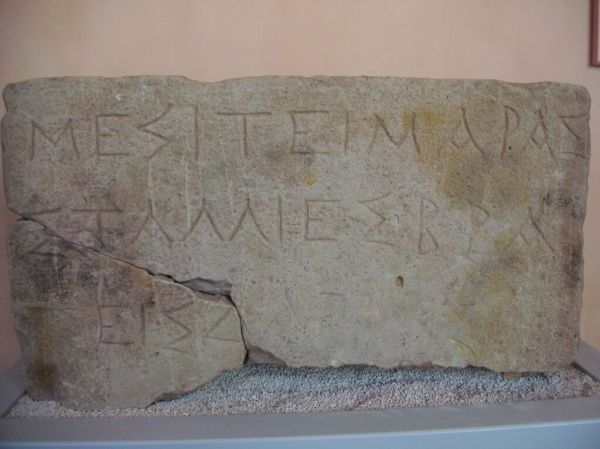
μεfιτει μαρασ σταλλιεσ βρα τεισ δατ[α]σ To Mefitis, Maras Stallies, for grace given Oscan inscription in the Greek alphabet. Rossano di Vaglio, 325-275 BC. Imagines Italicae: Potentia 13; Sabellische Texte Lu 16. This is an inscription on stone, found at the sanctuary site of Rossano di Vaglio (pictured below) in central Lucania, modern day... Continue Reading →
Songs about Pompeii
Most of you are probably familiar with the song "Pompeii", released by Bastille in 2013. A few weeks ago, Rachele De Felice sent me this link, of a rather nice Latin translation of the song. https://www.youtube.com/watch?v=VG_9Lw_6UrU She expressed some disappointment that the song had not been translated into Oscan, as the more ancient language of... Continue Reading →
So where is Narnia?
I'm still working away at my maps of the languages of ancient Italy. Going through all the examples of Greek inscriptions from Italy in the SEG, I found one from Narnia. I'd come across the ancient city of Narnia (modern-day Narni) when I was writing my book, and then kind of forgotten about it until this... Continue Reading →
From Oscan hirpus to English hearse
Myriapod Productions have released a rather lovely video in their "Mysteries of Vernacular" series tracing the etymology of the English word hearse back to the Oscan word hirpus, 'wolf'. (This was discovered and sent to me by my friend Julia, so many thanks to her! I have included some pictures of coins below, because she likes coins.) This... Continue Reading →
The Women’s Classical Committee UK
Over the past few months, I've been involved with the formation of the Women's Classical Committee UK. There's been an organisation for women in Classics in the US for a long time (the Women's Classical Caucus), and there's also an equivalent organisation in Australia and New Zealand. So when Liz Gloyn (among others) suggested a... Continue Reading →