So where is Narnia?

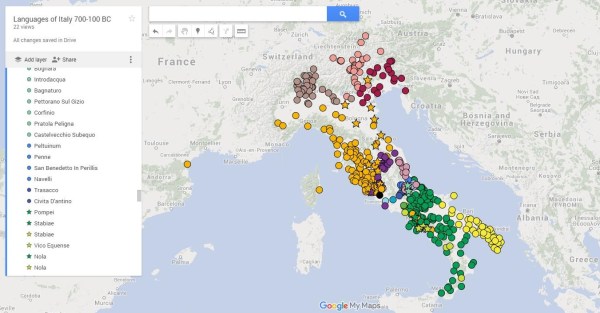
I'm still working away at my maps of the languages of ancient Italy. Going through all the examples of Greek inscriptions from Italy in the SEG, I found one from Narnia. I'd come across the ancient city of Narnia (modern-day Narni) when I was writing my book, and then kind of forgotten about it until this... Continue Reading →

Vanishing names on healing amulets

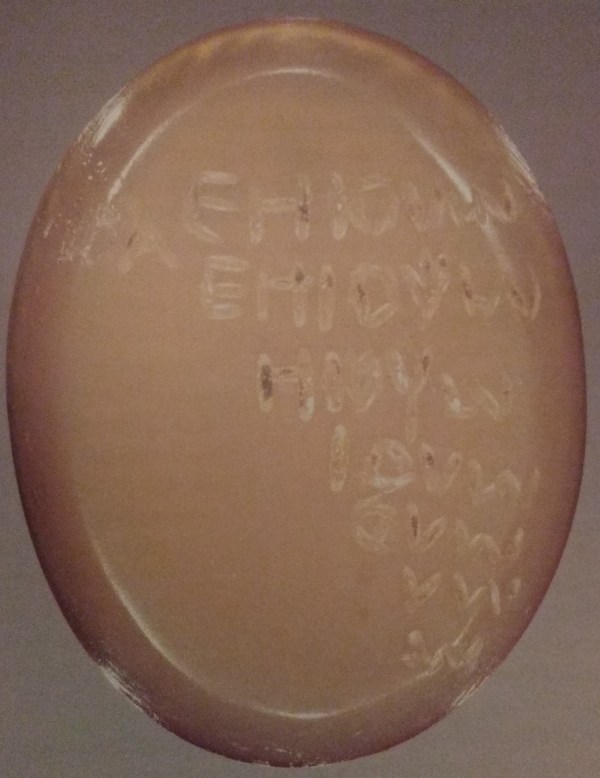
I'm reviewing a book this week called Vanishing Acts On Ancient Greek Amulets by Christopher A. Faraone. It's a short monograph that's incredibly rich in detail, using magical amulets in Greek, Latin and other languages to trace developments in how healing spells were spoken and written from the first century to the sixth century AD. In particular,... Continue Reading →

Four footprints, two languages, one tile

hn. sattiieis. detfri segnatted. plavtad herennis. amica signauit. qando. a- ponebamus. tegila(m)   Detfri of Hn. Sattis signed with a footprint. Amica of Herens signed when we were laying out the tile. Oscan/Latin inscription and four shoe prints on a large clay roof tile (0.67 x 0.94m). Pietrabbondante, c. 100 BC. Imagines Italicae: Teruentum 25;... Continue Reading →

Celtic and the Celts

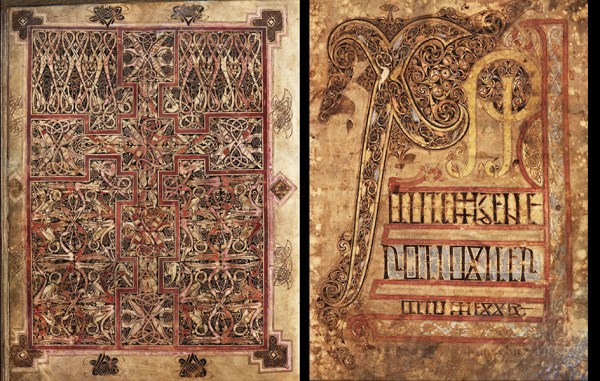
On Monday I finally got to see the British Museum's exhibit Celts: Art and Identity. It's a stunning collection, and if you can still get down to see it (or can see the re-jigged version when it transfers to the National Museum of Scotland), you should definitely catch it. Laura Cumming gives a great review here, with pictures... Continue Reading →

RAC/TRAC 2016

I'm pleased to announce that I'll be speaking at the upcoming Roman Archaeology Conference in March 2016, to be held at ‘Sapienza’ Università di Roma and the British School at Rome. The Theoretical Roman Archaeology Conference will be held at the same time. For now, the RAC website is a little sparse, but you can... Continue Reading →

Oscan in Early Modern Italy

One of my favourite things about studying an unusual language is that your research is very memorable. Once people associate you with a particular obscure language, they will immediately think of you whenever they hear about it elsewhere. And - even better - they will send you sources that you never could have found otherwise.... Continue Reading →

Was there non-Roman literature in Ancient Italy?

Fairly regularly, someone will ask me: was there Oscan (or Venetic or Etruscan or South Picene) literature? Or, sometimes a bit more aggressively, someone asserts that there definitely wasn’t an Oscan literary culture and therefore that Oscan-speakers and their societies were just less advanced than the Greeks and/or Romans. It's not that I think this... Continue Reading →

Create a website or blog at WordPress.com

Up ↑