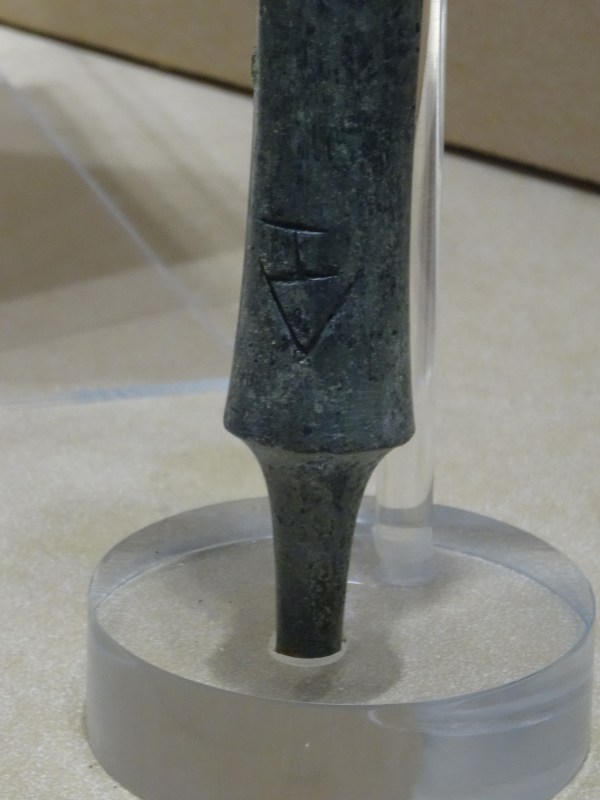
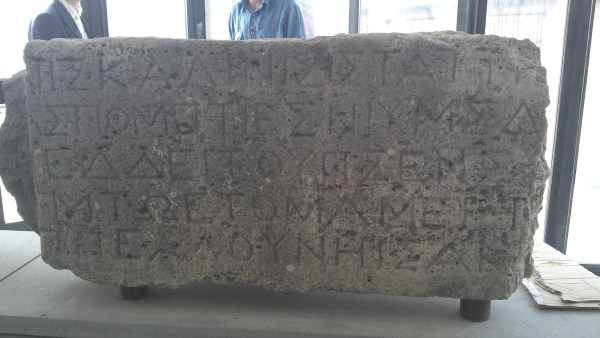
Today's inscription is a fantastic example of linguists getting a huge amount of information about ancient societies out of very short texts. How short? Well, about two letters actually. Buxentum 2 (c. 300 BC) reads <ΔΗ>, or <DE> to transcribe it into the Roman alphabet. The two letters are joined by one of their lines, to make... Continue Reading →
Corfinium – Italia or Italica?
Over the Easter holidays, I've been reading Mary Beard's SPQR, which I highly recommend. I was particularly pleased that so much of it focusses on early Rome and its relationship with Italy - it was at least a third of the way through before we even got to Sulla. Mary, as usual, brings out all... Continue Reading →
I, Sicily
I've recently started on a very exciting new collaboration with the I.Sicily project, which is building a fully searchable, freely available online corpus of the inscriptions of Sicily. (In my head I keep turning this project into "I, Sicily" in the manner of "I, Claudius" - this sounds quite dramatic, so I'm sticking with it.) To... Continue Reading →
Songs about Pompeii
Most of you are probably familiar with the song "Pompeii", released by Bastille in 2013. A few weeks ago, Rachele De Felice sent me this link, of a rather nice Latin translation of the song. https://www.youtube.com/watch?v=VG_9Lw_6UrU She expressed some disappointment that the song had not been translated into Oscan, as the more ancient language of... Continue Reading →
Mapping Language Contact – Phase 1
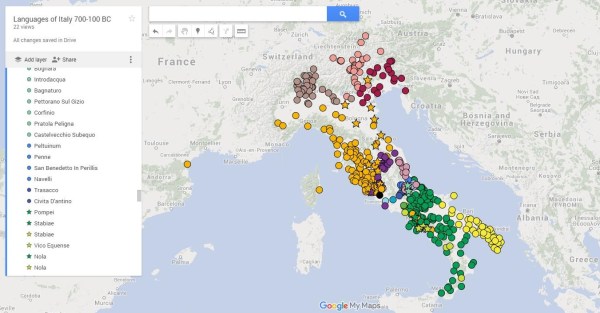
It's become a bit of a cliche for me that my academic talks tend to start with a map of the languages of Italy, followed by an explanation of why the map is dangerously misleading. The map that I normally use is from Wikipedia, and looks like this: Now, this map does the job in... Continue Reading →
Four footprints, two languages, one tile
hn. sattiieis. detfri segnatted. plavtad herennis. amica signauit. qando. a- ponebamus. tegila(m) Detfri of Hn. Sattis signed with a footprint. Amica of Herens signed when we were laying out the tile. Oscan/Latin inscription and four shoe prints on a large clay roof tile (0.67 x 0.94m). Pietrabbondante, c. 100 BC. Imagines Italicae: Teruentum 25;... Continue Reading →
Celtic and the Celts
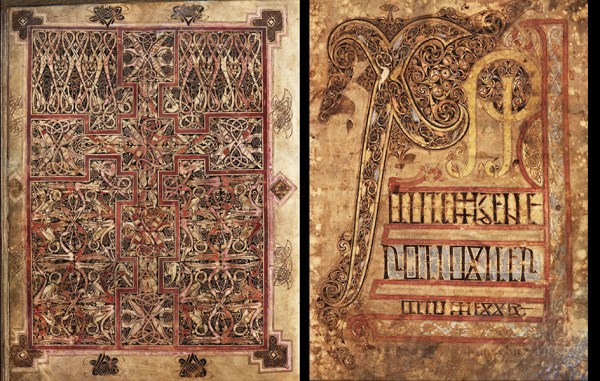
On Monday I finally got to see the British Museum's exhibit Celts: Art and Identity. It's a stunning collection, and if you can still get down to see it (or can see the re-jigged version when it transfers to the National Museum of Scotland), you should definitely catch it. Laura Cumming gives a great review here, with pictures... Continue Reading →
Review: Communication and Materiality
Here's my "Classics for All" review of Communitcation and Materiality: Written and Unwritten Communication in pre-Modern Societies. If you'd like to read the book, or selected chapters from it, you can currently download it for free from the De Gruyter website. Mostly a very good read, which introduced me to a lot of sources I wasn't familiar with... Continue Reading →
Greek in Italy at the Festival of Ideas and the Fitzwilliam Museum
The Cambridge Festival of Ideas rolls around again this week, with lots of great events to get involved with, including a lot of events in the Classics Faculty. As always, the Greek in Italy project has made a couple of contributions. Geoff's talk "Did Language Matter? Local Versus Imperial Languages in Classical Antiquity" has already sold... Continue Reading →
Classics, archaeology and linguistics themed cakes to celebrate the Bake Off Final
I'm not a skilled baker myself, but I highly appreciate baking excellence in others, particularly in the form of the Great British Bake Off. Tonight is, of course, this year's final (I'll be cheering for Nadiya), so it seems the perfect opportunity to plug some of my favourite Classics, archaeology and linguistics themed show-stoppers. Firstly... Continue Reading →