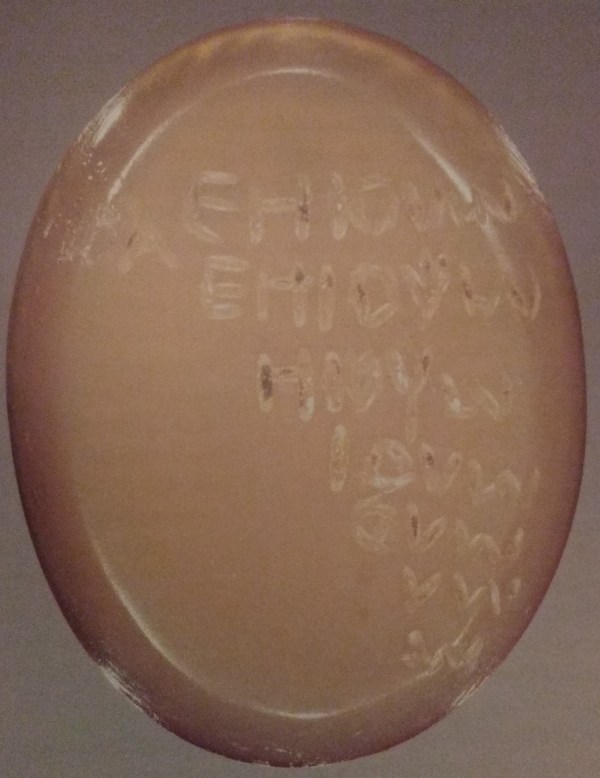
Vanishing names on healing amulets
I'm reviewing a book this week called Vanishing Acts On Ancient Greek Amulets by Christopher A. Faraone. It's a short monograph that's incredibly rich in detail, using magical amulets in Greek, Latin and other languages to trace developments in how healing spells were spoken and written from the first century to the sixth century AD. In particular,... Continue Reading →

Four footprints, two languages, one tile

hn. sattiieis. detfri segnatted. plavtad herennis. amica signauit. qando. a- ponebamus. tegila(m)   Detfri of Hn. Sattis signed with a footprint. Amica of Herens signed when we were laying out the tile. Oscan/Latin inscription and four shoe prints on a large clay roof tile (0.67 x 0.94m). Pietrabbondante, c. 100 BC. Imagines Italicae: Teruentum 25;... Continue Reading →

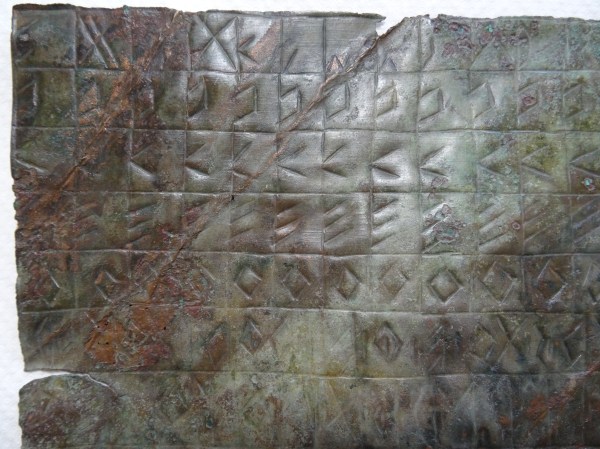
Oscan in Early Modern Italy

One of my favourite things about studying an unusual language is that your research is very memorable. Once people associate you with a particular obscure language, they will immediately think of you whenever they hear about it elsewhere. And - even better - they will send you sources that you never could have found otherwise.... Continue Reading →

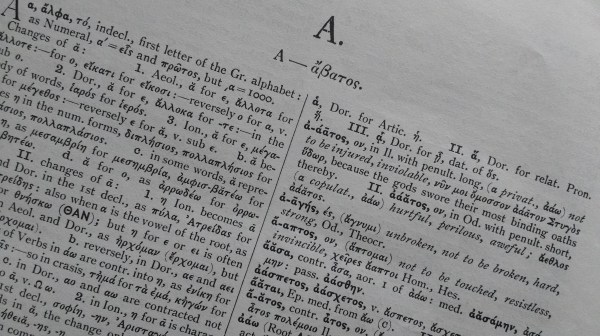
The problem with long alpha

This week, a lot of us who teach Classical Philology and Linguistics at Cambridge have been teaching our first essay of the first year course on the sounds of Greek and Latin. I had a request from a student for a good example of the difference between long and short alpha, which really stumped me for a... Continue Reading →

Why Do Greek Plays have Latin Titles?

One of the most famous Greek tragedies is called Oedipus Rex. Well, sort of. Its original Greek title is Oidípous Týrannos, but usually everyone calls it by its Latin name. Even the English title Oedipus the King is heard much more rarely. And it's not just this play that's the problem. Ancient Greek plays are... Continue Reading →

What is the Latin for “to tweet”?

Earlier today I tweeted a quote from an article by the University Orator, Rupert Thompson, in our Faculty newsletter. The Orator gives speeches in Latin when honorary doctorates are conferred - and writing speeches in Latin to honour the work of particle physicists, Hollywood actors, and the like, is not always straightforward. It's an almost unique... Continue Reading →

Two Latin words for elephant

There are two words for “elephant” in Latin, and both have to do with Greeks in Italy. The first one, elephantus (or sometimes elephas or elephans), is fairly straightforward. It’s used in Latin from about the second century BC, and it’s a borrowing of the Greek word ὁ ἐλέφας, –αντος. That’s the normal Greek word for both African and Indian elephants, and is... Continue Reading →

Create a website or blog at WordPress.com

Up ↑