The Cambridge Greek Play desperately needs a new website. Very soon, I'm pleased to say this website will become a reality, and I will certainly be plugging it and providing links when it launches. Fortunately, we are paying some highly talented and professional designers to construct the website itself, thanks to a donation reserved for... Continue Reading →
Blog
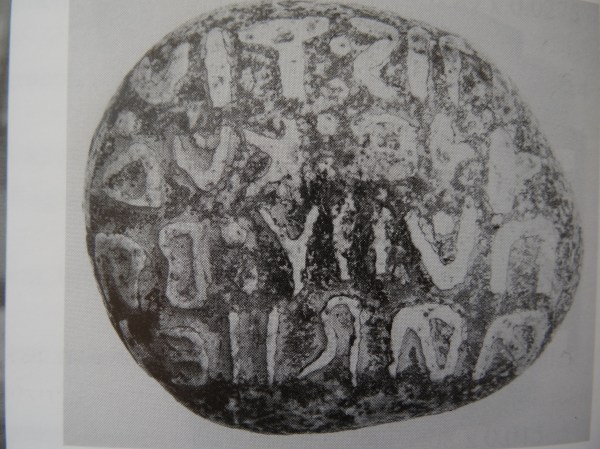
A 2500-Year-Old Tribute to a Lost Friend
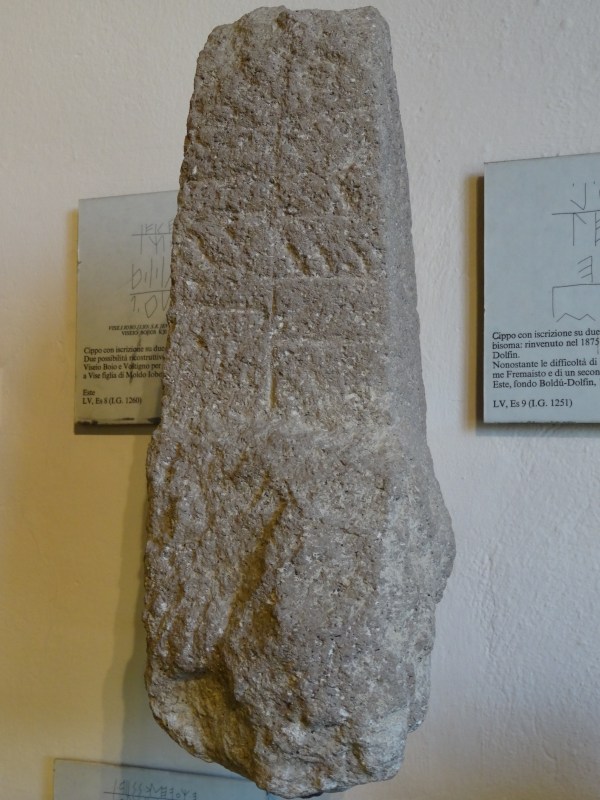
ego vhontei ersiniioi vineti karis vivoi oliialekve murtuvoi atisteit I (am a grave) for Fonts Ersinios (He was) Vinetos's friend. He (Vinetos?) sets (me) up for (him), whether alive or dead. (Venetic inscription on stone. Este, Italy. c. 500-475 BC. M. Lejeune "Manuel de la Langue Vénète", #75 ter) I was very struck by this inscription the first... Continue Reading →
Words for “alphabet” in ancient languages
I remember when I first realised that the English word "alphabet" came from the first two letters of the Greek alphabet - alpha and beta - and somehow I felt like I'd cracked a kind of etymological code. But the list of brilliant names for alphabet terms just goes on. The word "alphabet" is of... Continue Reading →
Cambridge Greek Play 2013 released on YouTube
I had a very fun morning yesterday (in between marking up final page proofs), because I was able to announce the release of the Cambridge Greek Play 2013 on YouTube. Thanks to a donor, both PROMETHEUS and FROGS were filmed over several performances, and John Watts and Helen Eastman have since worked very hard to... Continue Reading →
From Neapolis to Calimera (aka Greek in Italy goes to Italy)
Last week was our second "Greek in Italy" project trip to the south of Italy. Like our last trip in September 2014, I'm sure that pictures and thoughts from this trip will keep bubbling up in my blog posts and articles for quite some time. But even though we've only just got back and I've... Continue Reading →
Why Do Greek Plays have Latin Titles?
One of the most famous Greek tragedies is called Oedipus Rex. Well, sort of. Its original Greek title is Oidípous Týrannos, but usually everyone calls it by its Latin name. Even the English title Oedipus the King is heard much more rarely. And it's not just this play that's the problem. Ancient Greek plays are... Continue Reading →
Umbrian in Tolstoy
My holiday reading this year was Tolstoy's Anna Karenina, which I had been meaning to read for a while. For the first three hundred pages, it was a total escape from work - but then what should pop up in Part III but a reference to Umbrian: Alexei Alexandrovich ordered tea to be served in... Continue Reading →
A Stone Talking to Itself
pis: tiú: íív: kúrú: púiiu: baíteís: aadiieís: ahfineís: Who are you? I am a stone. Whose? Baitis Aadiis Afinis's. (Oscan inscription on stone. Altilia, Italy. c. 150-90 BC. Imagines Italicae: Saepinum 2, Sabellische Texte: Sa 31) It's not often that I'm tempted to describe an inscription as "cute", but I've always found this short Oscan... Continue Reading →
What is the Latin for “to tweet”?
Earlier today I tweeted a quote from an article by the University Orator, Rupert Thompson, in our Faculty newsletter. The Orator gives speeches in Latin when honorary doctorates are conferred - and writing speeches in Latin to honour the work of particle physicists, Hollywood actors, and the like, is not always straightforward. It's an almost unique... Continue Reading →
Why Historians and Linguists Should Read the Ibis Trilogy
Historians and linguists of the world: you should be reading Amitav Ghosh's Ibis Trilogy - Sea of Poppies, River of Smoke, and the recently released Flood of Fire. (For those who have already started Flood of Fire, don't worry, there are no spoilers ahead.) I'm hoping the historians don't need too much convincing. Ghosh's trilogy... Continue Reading →