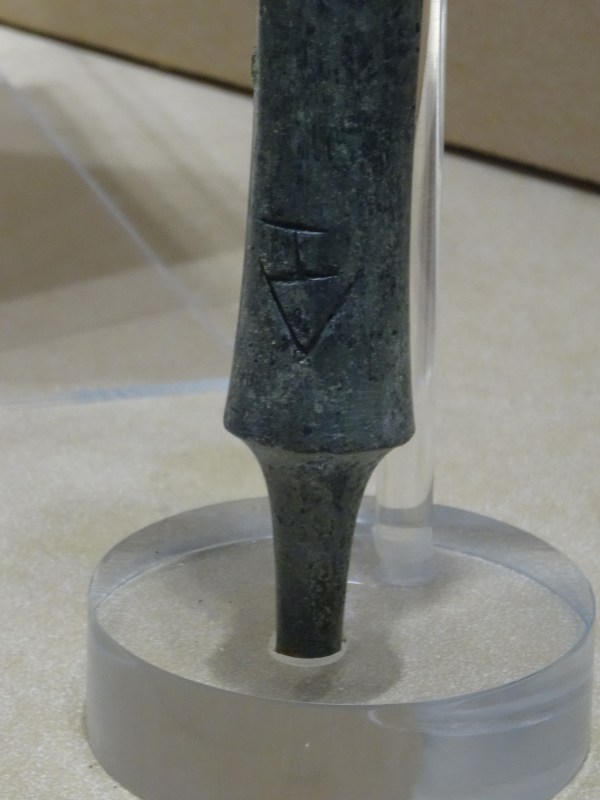
Today's inscription is a fantastic example of linguists getting a huge amount of information about ancient societies out of very short texts. How short? Well, about two letters actually. Buxentum 2 (c. 300 BC) reads <ΔΗ>, or <DE> to transcribe it into the Roman alphabet. The two letters are joined by one of their lines, to make... Continue Reading →
The WCC Launch and an EpiDoc Workshop
It’s been a busy week for me this week, with two big events taking up all of my time. The first was the launch of the Women’s Classical Committee UK, and the second was a digital humanities workshop for training in EpiDoc XML mark-up and other digital methods. A week of contrasts, and lots of... Continue Reading →
Reblogged – What the digamma?
An excellently Classical post appeared on the Strong Language linguistics blog last week after someone found the phrase "what the digamma?" in a poem of 1881. I'll let you read Ben Zimmer's musings on whether this is a joke replacement of "what the dickens" or is meant as something closer to "WTF". The comments give... Continue Reading →
I, Sicily
I've recently started on a very exciting new collaboration with the I.Sicily project, which is building a fully searchable, freely available online corpus of the inscriptions of Sicily. (In my head I keep turning this project into "I, Sicily" in the manner of "I, Claudius" - this sounds quite dramatic, so I'm sticking with it.) To... Continue Reading →
The Women’s Classical Committee UK
Over the past few months, I've been involved with the formation of the Women's Classical Committee UK. There's been an organisation for women in Classics in the US for a long time (the Women's Classical Caucus), and there's also an equivalent organisation in Australia and New Zealand. So when Liz Gloyn (among others) suggested a... Continue Reading →
Vanishing names on healing amulets
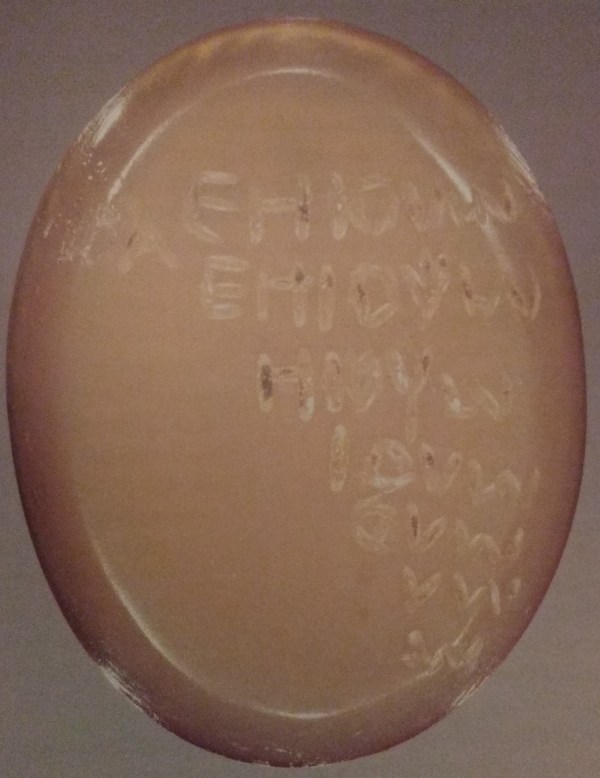
I'm reviewing a book this week called Vanishing Acts On Ancient Greek Amulets by Christopher A. Faraone. It's a short monograph that's incredibly rich in detail, using magical amulets in Greek, Latin and other languages to trace developments in how healing spells were spoken and written from the first century to the sixth century AD. In particular,... Continue Reading →
The problem with long alpha
This week, a lot of us who teach Classical Philology and Linguistics at Cambridge have been teaching our first essay of the first year course on the sounds of Greek and Latin. I had a request from a student for a good example of the difference between long and short alpha, which really stumped me for a... Continue Reading →
“Oscan in Southern Italy and Sicily” is out this week
I'm very excited to announce the publication of my book Oscan in Southern Italy and Sicily. The editor very kindly dropped the first copy round to my house last night, and I'm really pleased with how it has turned out. This book started life as my PhD thesis (pictures of its journey from thesis to book... Continue Reading →
Why do some Greek and Latin words mean (almost) the opposite in English?
As a learner of Greek or Latin, you are sometimes confronted by words that seem to have obvious counterparts in English - and most of the time, that's very helpful. English has borrowed lots from the ancient languages, particularly from Latin (often via French). Sometimes a word means exactly what it should in a weird... Continue Reading →
Archiving the Cambridge Greek Play
The Cambridge Greek Play desperately needs a new website. Very soon, I'm pleased to say this website will become a reality, and I will certainly be plugging it and providing links when it launches. Fortunately, we are paying some highly talented and professional designers to construct the website itself, thanks to a donation reserved for... Continue Reading →