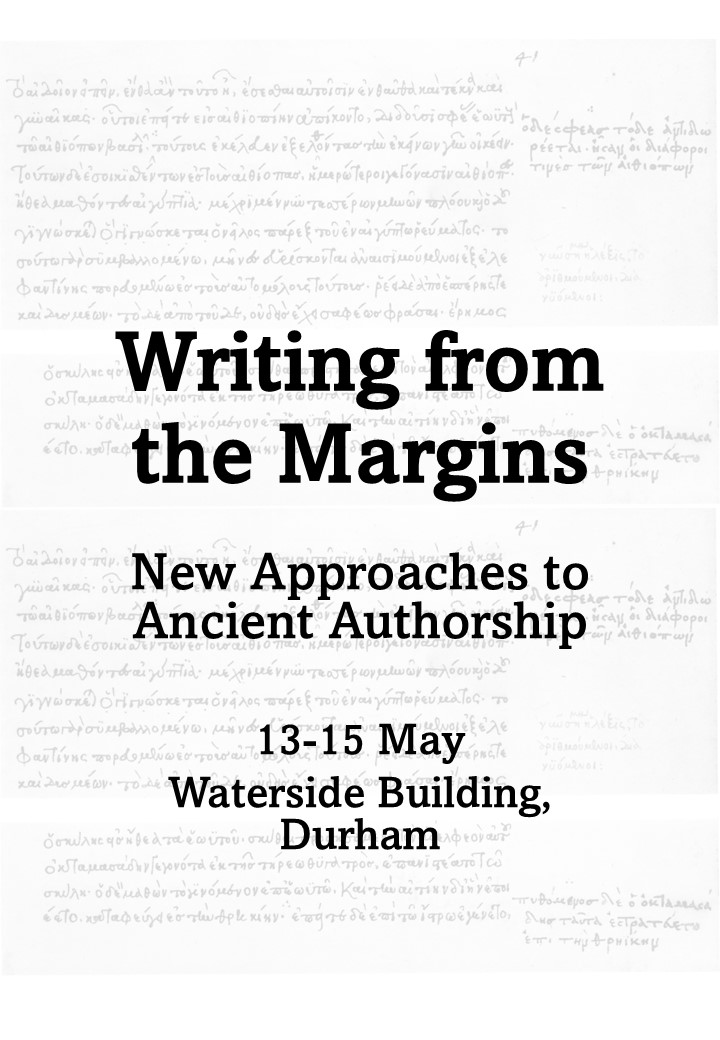
Last week (alongside Erica Bexley and Lucy Jackson) I hosted the conference ‘Writing from the Margins: New Approaches to Ancient Authorship’. The call for papers and programme are linked here if you’re interested in seeing more about our ideas and the speakers the conference attracted.
Although I didn’t give a paper myself, Erica and I decided to give some summing-up thoughts on the final day of the conference, and I just want to reflect on a few of these ideas here as well.
As you can see, the questions we were asking felt fairly ambitious:
“Key questions for the conference include: 1) how were slaves, freedmen/freedwomen, and non-citizens involved in the creation of ancient texts and 2) how can we better appreciate texts’ dissemination and preservation by anonymous or uncredited intermediaries such as scribes, pedagogues, graffitists, and performers in the theatre? Building on recent contestation of rigid identity categories, we see ‘status’ itself (in terms of class, race, ethnicity, (dis)ability, citizenship) as fluid and moveable, with individuals moving between enslaved/free, elite/non-elite, citizen/foreigner, disabled/abled during their lifetime or, in some cases, depending on the eye of the beholder.”
The three of really wanted (as an epigrapher/linguist/historian and two literature and theatre scholars, respectively) to get a hold of these questions using sources and approaches both from ancient literature and from material culture. However, this is more easily said than done – I think we’ve all been in situations where a conference or seminar series that has purported to be ‘interdisciplinary’ instead seems to consist of people from different disciplines talking past each other.
This conference couldn’t have been more different. There was genuine, enthusiastic engagement across disciplinary boundaries – perhaps helped by the fact that everyone was truly onboard with the approach and questions of the conference. The speakers were all such genuinely nice people that I think everyone who spoke got a supportive, constructive discussion after the paper. I was really blown away by how focused and insightful everyone was.
I don’t know exactly where I thought we would be going with the discussion, but some elements of it took me by surprise. A lot of the ideas were works in progress, and I don’t want to scoop anyone, so I won’t give any detailed comments about the speakers’ work here. But something that really emerged for me was the role of the individual, and specific individual choices, in ancient authorship, even where those authors are unknown, marginalised or anonymous. I guess I thought that lots of people would be interested in talking about collaborative, layered authorship (for example, by troupes of actors and the author putting together a play; or the many people involved in writing and carving an inscription), but although that idea did feature it was actually the individual level of authorship that shone through in many papers.
In particular, this really enhanced the role of women in (for example) setting up inscriptions to their loved ones. Several presenters, including Magdalena Streicher, Katherine Backler and Abigail Graham emphasised the importance of personal relationships in inscriptions. This was a theme that also came back in the presentations about literary production and the role of enslaved scribes in the recording of elite literature.
As so many speakers were talking about slaves and freed slaves, I also got loads of ideas for new directions for my current project – none of which I’ve yet been able to follow up. But I really appreciate everyone taking the time to talk to me about different aspects of their work and my own. I had a wonderful time and (in a good way) I’ve come away with more questions than answers.



Leave a Reply